Yes in morse code
Three letters and 8 marks. Press Play to hear it and see it blink. On the air, operators often send a single letter instead.
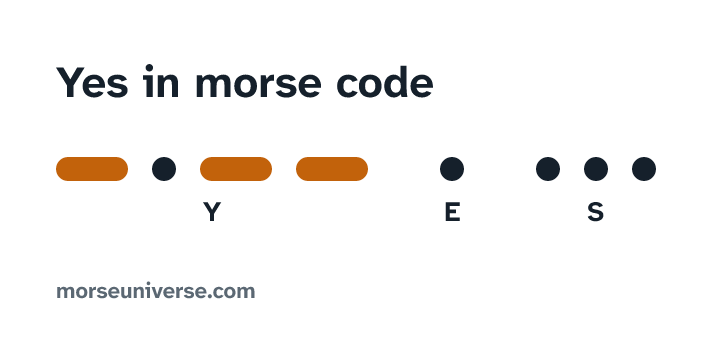
-.-- . ...
The flashlight needs camera access. Nothing is recorded or sent.
How to blink Yes with a flashlight
Count a steady beat. A dit (the short signal) is one count of light, and a dah (the long one) is three. Stay dark for one count between flashes and three counts between letters.
- Y: one long, one short, two long.
- E: one short flash.
- S: three short flashes.
- Stay dark for seven counts, then start again from the first letter.
Download Yes in morse code
The pattern as a picture, each letter named under its marks, for a card, a craft project or a tattoo sketch. The PNG is ready to print or share; the SVG scales to any size.
Yes as a morse code bracelet
Each dit is a round bead and each dah a tube three times as long, with a small spacer between letters. For a 7 in bracelet in 3 mm beads: 5 dit beads, 3 dah tubes, 2 spacers and 44 plain beads.
How yes is put together
Y is a dah, a dit and two dahs, E is a single dit and S is three dits. That adds up to 8 marks. At 10 words per minute (WPM), the speed the player starts at, yes takes 25 units, about 3 seconds.
How radio operators say yes
ITU-R M.1172, the list of abbreviations for radio at sea, gives C as yes: a dah, a dit, a dah and a dit. Sent straight after certain Q codes, C gives the code a yes meaning and NO gives it a no.
Amateur operators often use R instead. The International Amateur Radio Union’s operating guide lists it as roger, yes, I confirm or received. It is three marks, a dit, a dah and a dit, against eight for yes.
And no
No is N (a dah and a dit) and O (three dahs), five marks. ITU-R M.1172 lists NO as no, and the amateur guide shortens it to N alone.
Questions
What is yes in morse code?
A dah, a dit and two dahs for Y, one dit for E and three dits for S. That's 8 marks, and the Copy morse button above copies it as text.
What are yes and no in morse code?
Yes is Y, E and S; no is N (a dah and a dit) and O (three dahs). ITU-R M.1172 also lets C stand for yes and NO for no.
How do you blink yes in morse code?
Follow the steps above, one letter at a time, with one count of dark between flashes and three between letters. Press Play first to watch the lamp keep the rhythm.
How do you say OK in morse code?
O is three dahs and K is a dah, a dit and a dah. ITU-R M.1172 lists OK as meaning we agree, or it is correct.
What does dit dah dit mean in morse code?
It is the letter R. On the air, R on its own means received, and the International Amateur Radio Union's operating guide also gives it as roger or yes.
More morse tools
- Morse code translator
Type any text to hear it in morse, or paste morse to read it.
- Printable morse code chart
Every letter and number drawn to scale, for US Letter and A4.
- Morse code numbers
0 to 9, and the pattern that makes them quick to learn.
More phrases in morse code
- Happy birthday in morse code
Thirteen letters in two words, 41 marks in all.
- Hello in morse code
Five letters and 16 marks, with the double L in the middle.
- Help in morse code
Four letters and 13 marks.
- Help me in morse code
Six letters in two words, 16 marks in all.
- Hi in morse code
Six dits and nothing else, four for H and two for I.
Sources
- Codes and timing follow Recommendation ITU-R M.1677-1 (10/2009), International Morse code (International Telecommunication Union, 2009).
- Recommendation ITU-R M.1172: Miscellaneous abbreviations and signals to be used for radiocommunications in the maritime mobile service (International Telecommunication Union, 1995).
- Ethics and Operating Procedures for the Radio Amateur (edition 3) (International Amateur Radio Union, 2010).